


In my previous article, I described a professional who had discovered the power of artificial intelligence and enthusiastically produced a 70-slide presentation, a fifteen-tab Excel workbook, and a comprehensive market report. Meanwhile, the management team needed something much simpler: a decision.
But after thinking about it, I realized that perhaps the more interesting part of that story begins when the presentation reaches its audience.
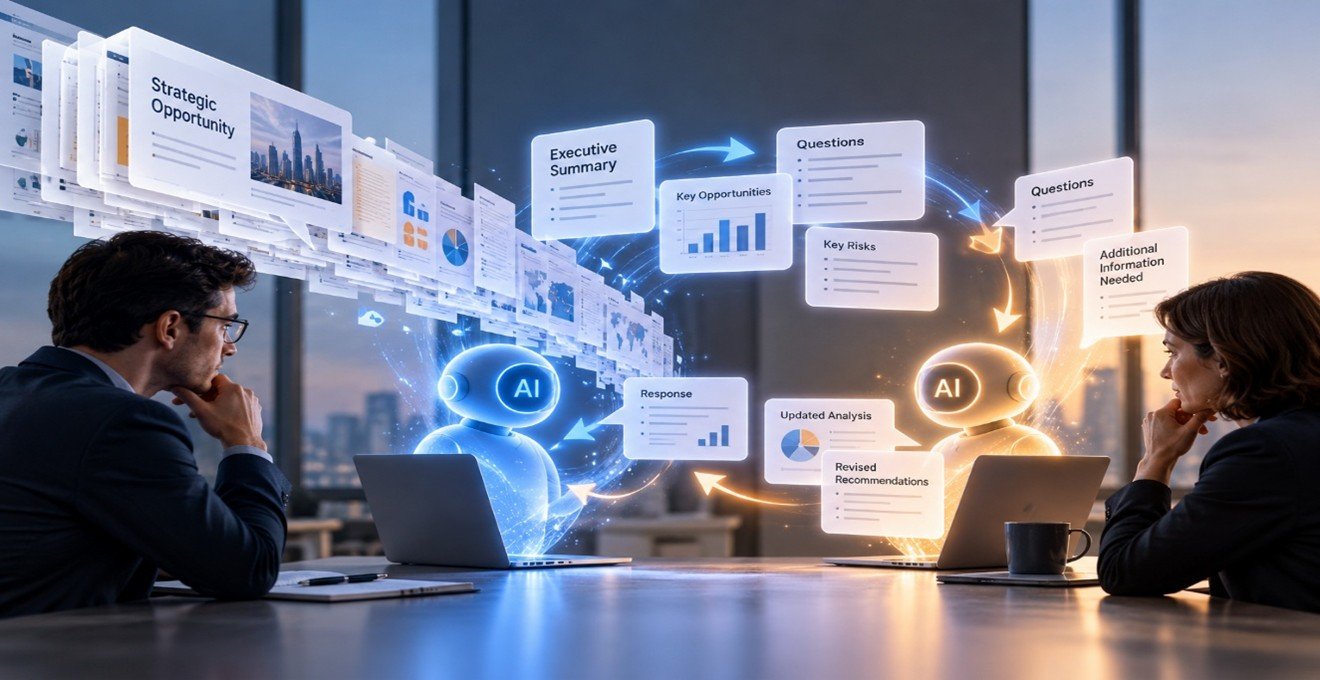
The director (department head, or CEO) receives the seventy slides shortly before another meeting. With limited time, she uploads the document to her AI assistant and asks for a summary of the main arguments, weaknesses, and recommended actions. Within seconds, a concise and convincing response appears.
The director asks the same AI tool to draft an email questioning the financial assumptions and requesting clarification on three risks.
The manager who created the original package receives the email, uploads it to her own AI assistant, and asks for a precise reply, an updated financial model, and, of course, additional AI-revised slides.
The director receives the response and once again asks AI to evaluate it. Perhaps the next version goes to a vice president (or upper manager), who uses another tool to summarize the entire exchange, and so on.
Nobody in this example is necessarily careless. Each person is using AI to manage a demanding workload. The documents are produced faster, feedback is delivered faster, and the process appears remarkably efficient.
But are the two professionals actually communicating with each other?
When technology becomes the conversation
It is tempting to see this as simply the next stage of productivity. We already use spellcheckers, search engines, calculators, and software to make our work easier. Why should AI be different? Perhaps it will not be.
An AI assistant might identify a bad assumption, uncover a missing source, or even challenge a recommendation that a busy manager would otherwise accept. Using AI to review AI-assisted work isn’t, per se, a problem. Yet, if you think about it, something feels strange when technology begins formulating both the argument and the response.
Perhaps because the employee hasn’t examined every recommendation in the original presentation. Or maybe because the director hasn’t read the original evidence. Incredibly, both can exchange persuasive, professional messages without necessarily engaging deeply with the underlying issue.
Research makes this question worth exploring. In a 2025 study by researchers at Microsoft and Carnegie Mellon University, 319 knowledge workers described 936 real-world uses of generative AI. Greater confidence in AI was associated with less self-reported critical-thinking effort. The findings do not show that AI damages thinking, but they do suggest that we trust these tools matters.
Another experiment, involving Boston Consulting Group, found that participants using GPT-4 performed about 23% worse on a business problem-solving task outside the tool’s capabilities than participants without AI. That result doesn’t describe every AI-assisted task, but it reminds us that polished output doesn’t guarantee sound judgment.
Now imagine what would happen if the original market analysis contained one plausible but incorrect assumption. The employee’s AI uses it to build a forecast. The director’s AI summarizes the forecast. Another AI drafts a response defending it. The discussion grows more sophisticated, while the original assumption may remain untested.
I just wonder if this is a new form of productive collaboration? Or might it sometimes create the appearance of a discussion that nobody has truly had? A second question would be about accountability in case of a mistake.
And… what happens to the people in the middle?
Perhaps the most interesting question is not whether AI can communicate effectively. We all know it clearly can generate arguments, counterarguments, summaries, and explanations. The question is what will happen (or is happening now) to our role as professionals as more of those exchanges are mediated by machines.
Could we become better decision-makers because AI helps us explore more perspectives? Or could we gradually become less familiar with the reasoning behind our own recommendations?
Would a short conversation between the employee and director reveal more than several rounds of carefully generated correspondence? Or might AI help them arrive at that conversation better prepared?
These possibilities are not mutually exclusive. The result may depend on how gradually we adopt AI, how carefully we check evidence, and whether someone along the chain remains willing to explain and make the final decision.
This is also a question for leadership development and executive coaching. Beyond learning to use new tools, professionals may need to reflect on their habits: When do I genuinely understand a recommendation? When am I accepting a convincing explanation because it sounds right or complex? When would a direct conversation be more valuable than another automated response?
I do not think we have enough experience with this way of working to predict where it will lead. Perhaps AI will make our conversations more knowledgeable, our disagreements more constructive, and our decisions better. Or perhaps it will also make it easier to participate in discussions without fully engaging in them.
Only time will tell (and we all know it will not be long).
I’ll leave you with a thought. The next time you receive an impressive report and quickly reach for an AI tool to summarize it, consider asking yourself a simple question: Who is actually having this conversation?
Alexander Martinez
References
1. Lee, H.-P., et al. (2025). “The Impact of Generative AI on Critical Thinking: Self-Reported Reductions in Cognitive Effort and Confidence Effects From a Survey of Knowledge Workers.” Microsoft Research / Carnegie Mellon University.
2. Dell’Acqua, F., et al. (2023). “Navigating the Jagged Technological Frontier: Field Experimental Evidence of the Effects of AI on Knowledge Worker Productivity and Quality.” Harvard Business School Working Paper.