



If you look through my blog archives, you might come across an earlier post where I criticized professionals for creating PowerPoint presentations overloaded with data or text, making them ineffective for business use. That topic is still relevant today, but it has taken on new dimensions. In this follow-up, I explore how AI has transformed the landscape, introducing fresh challenges alongside new possibilities.
Not long ago (about a year ago), preparing a comprehensive business analysis took real effort. Researching data, building financial models, crafting presentations, and organizing recommendations could take days or even weeks. Now, with powerful new AI tools, much of that work can be completed in minutes. But that’s where a new problem emerges.
Think about a manager who’s just discovered these capabilities. Amazed at what’s possible, she decides to prepare a commercial strategy for an upcoming management meeting. In an hour, she produced a 70-slide presentation, a complex Excel workbook with fifteen tabs, and a market report covering competitors, customer segments, financial projections, and recommendations. The result looks quite impressive.
She is for sure thrilled. What took days is now done in record time (and without any effort). Proudly, she shares everything with the management team. But then a new issue arises.
The team didn’t need seventy slides, fifteen spreadsheets, or a comprehensive market report. They needed a decision about whether to enter a new market. Instead of a clear recommendation backed by essential evidence, managers now face a mountain of information, dozens of scenarios, super-complex Excel sheets to understand, and calculations or models no one has time to review.
The manager saved herself several days of work. But now, their colleagues may spend hours just trying to make sense of it all. And the actual decision might take even longer!
Ironically, we used to waste time creating unnecessary work. Now, our productivity tools let us waste everyone else’s time—just a lot faster.
More information doesn’t necessarily mean better decisions
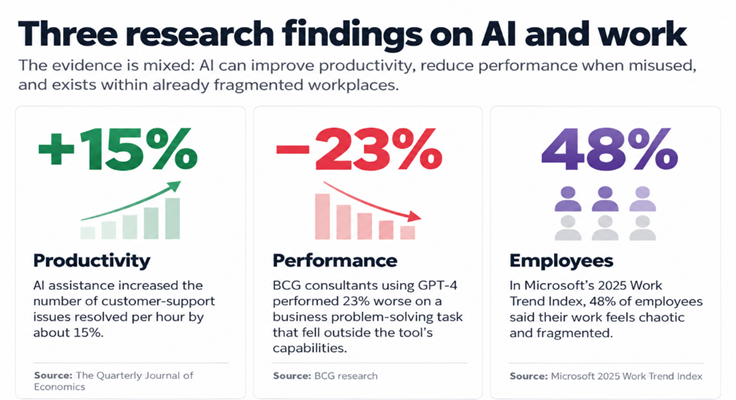
I want to be 100% clear. This isn’t an argument against new technology or modern tools, quite the opposite. These advances offer real opportunities to improve how professionals research, analyze, communicate, and make decisions. And the productivity benefits are well documented. For instance, some studies show that digital tools increase the number of issues resolved per hour by as much as 15%.
But productivity isn’t always the same as business value. Other research suggests that in complex or unfamiliar situations, heavy reliance on tools can actually make performance worse, especially when users are unaware of their limitations.
This distinction becomes particularly important as we use increasingly sophisticated business materials. For years, companies have struggled with overly complicated reports, spreadsheets full of formulas, presentations that never reach a point, and analyses that nobody has time to read. Technology hasn’t created this behavior; it has simply removed the old barriers that once limited it.
Why evaluate three scenarios when you can generate thirty? Why write a short recommendation when you could create a comprehensive assessment? Why keep a financial model simple when you can make it more elaborate? Because the ability to produce information isn’t the same as the ability to identify what matters.
Now consider two business development managers evaluating a new market opportunity.
The first creates a massive strategy document, complete with competitor analyses, financial projections, and detailed recommendations, confident that the material’s sophistication proves its value.
The second starts differently. She uses her own knowledge to pinpoint the most important commercial questions, focus on key customers, and understand what their company can realistically deliver. She then uses available AI tools to dig deeper, check assumptions, and explore alternatives.
After reviewing the findings, they prepare a concise recommendation highlighting the opportunity, main risks, and the decision required. Both managers have access to the same AI tools. But only one shows how professional judgment adds value.
The difference isn’t technological skill. It’s discernment and judgment.
The real skill is knowing what not to produce
There’s another aspect to this challenge that professionals often overlook: the time and attention of their colleagues.
Recent surveys show that nearly half of employees describe their work as chaotic and fragmented. This isn’t just about technology causing problems; it’s about the environment in which we’re using ever more powerful tools to generate content.
A sophisticated financial model isn’t valuable just because it has thousands of formulas. A report isn’t useful simply because it covers every possible question. And an analysis isn’t better because it considers more variables than anyone can realistically evaluate.
These materials are meant to help someone understand an issue, weigh options, or make a decision. If they complicate that process, their complexity loses its value.
Here are some ideas on how to use AI when preparing business materials:
- Begin with the decision. Before producing anything, clarify what your audience actually needs to know or decide.
- Use your AI tools to challenge your thinking: test assumptions, identify weaknesses, and explore alternatives, rather than simply generating more material.
- Validate what matters. Sophisticated models and confident recommendations can still be built on faulty assumptions or unreliable information.
- Respect your colleagues’ time. The effort you save for yourself should not become extra work for those who receive your output.
- Develop real judgment, not just technical skills. Coaching can help professionals strengthen their ability to prioritize, communicate clearly, question assumptions, and distinguish genuine contribution from busy work.
- Ultimately, remember that the goal isn’t to be the person who produces the most impressive materials with technology. It’s to be the professional who uses all available tools to deliver clearer thinking, better communication, and more effective decisions.
For years, organizations have struggled with information overload, unnecessary complexity, and the tendency to confuse the volume of work with the value of its results. Now, technology allows us to multiply that volume almost instantly.
Our AI tools have made it easier than ever to create. But they haven’t made it easier to decide what’s worth creating in the first place. And perhaps that’s the real professional advantage: not knowing how to produce more but knowing when less is truly more.
Alexander Martinez
References
- Brynjolfsson, E., Li, D., & Raymond, L. R. (2025). Generative AI at Work. The Quarterly Journal of Economics. Research on productivity improvements among customer-support agents.
- Dell’Acqua, F., et al. (2023). Navigating the Jagged Technological Frontier: Field Experimental Evidence of the Effects of AI on Knowledge Worker Productivity and Quality. Harvard Business School Working Paper. Research involving BCG consultants, including tasks on which AI assistance reduced performance.
- Microsoft (2025). 2025 Work Trend Index Annual Report. Research on workplace fragmentation, productivity pressures, and AI adoption.